
The World's Best Cities: Medellín, Colombia
I arrived carrying around this version of Colombia that had been built for me when I was a young kid. I left with one I had actually experienced.

The digital version of Reject Average Magazine is available free to read this and all other articles. If you want to read it as intended click here and subscribe to the digital version, no cost, no credit card, instant access.

Colombia has always occupied a strange place in my mind. I grew up in the 1980s when the name Colombia was almost inseparable from Pablo Escobar, the Medellín Cartel, cocaine and violence. Movies and television reinforced all of it. For a kid growing up in that era, those images become baked into a country's identity whether you realize it or not.
Then about ten years ago, one of my best friends moved to Medellín to open a Spanish immersion school. Every few weeks we'd talk, and he would rave. The people. The food. The weather. The cost of living. He loved it.
Slowly my version of Colombia started to change. By then I had traveled enough to understand one of the recurring lessons of my life: what you think you know about a place from television, movies and the news is rarely what you find when you actually get there.
So when our 52 Countries in 52 Weeks journey brought us to Medellín, I was ready to finally see it for myself. Within a few days, I understood what my friend had been talking about.
The first thing you notice is the people. Medellín feels young, energetic, stylish and intensely fitness oriented. People are running, and cycling everywhere. Bike paths and running trails are busy from morning to evening. Athletic gear and yoga pants seem to be the unofficial uniform. You can feel the culture of health and movement right outside the door. It's infectious.
Medellín has leaned into modern development in a way I wasn't expecting. High-rise residential towers dominate parts of the skyline with pools, gyms, common areas and theaters built in. One of the criticisms of a place like Dubai is that all the newness makes it feel sterile. Medellín is the opposite. The modern architecture feels purposeful, even joyous, like a city excited about what it's becoming rather than just trying to look impressive. And somehow it sits right against the jungle.
Less than twenty minutes from the city, we went on a waterfall hike, and just like that, Medellín disappeared. We were in raw, green, tropical landscape that felt a world away from the towers and running trails we had just left. Very few cities of this size give you that combination. Modern life at scale with something genuinely wild that close.
The weather helps too. It felt more like San Diego than the hot, humid South American jungle I had somehow pictured. The city is called the City of Eternal Spring for a reason.
Then there was the food. Medellín is home to the only restaurant during our entire year long journey that we went back to twice. It wasn't a famous destination or elaborate tasting menu. It was a small, unassuming breakfast and lunch place with spectacular food, a brilliant menu and prices that seemed almost absurd for how good everything was. My daughter and I were talking about lunch the next morning and just looked at each other. Let's go back. In 52 countries, we almost never repeated anything. Medellín earned the exception.
The part of the trip I found most interesting was its relationship with its past. We spent a day going through the Pablo Escobar story, visiting places connected to his life and spending over an hour with someone who had known him personally. Her stories were fascinating and contradictory in the way real history usually is.
We also walked through Comuna 13, once one of the most dangerous neighborhoods in the city, now transformed into an art-filled tourist destination with murals, galleries, music and a remarkable system of outdoor escalators built into the steep hillside streets. The city hasn't pretended its past didn't happen. It decided to keep moving anyway. Maybe that's why the place feels so alive.
If I had to compare Medellín to another South American city, Buenos Aires comes closest. Similar richness and culture. But Medellín felt younger, lighter and more fun to me. Less attitude, more celebration.
I arrived carrying around this version of Colombia that had been built for me when I was a young kid. I left with one I had actually experienced. That alone makes Medellín worth the trip.

The Reject Average 500
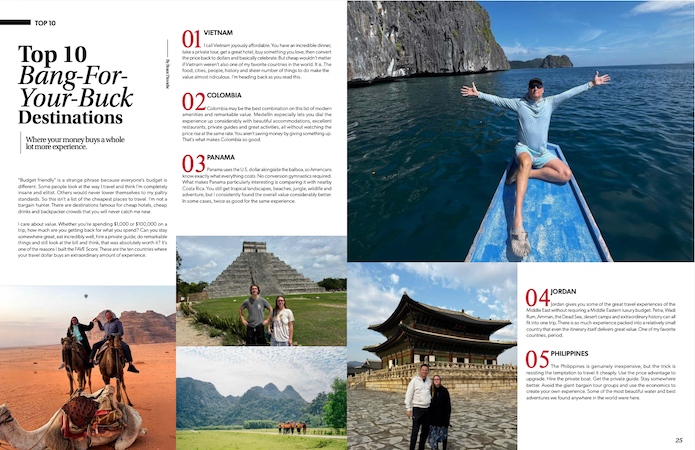
Top 10 Bang For Your Buck Destinations
Get The Whole Story!
Read all the complete articles, get every issue directly delivered to your door, or online to your device. Welcome to Reject Average Travel and Adventure Magazine.
Subscribe now and get:
-
Quarterly issues delivered to your door
-
The complete 52-week travel breakdown
-
Exclusive member travel deals and experiences
-
Access to curated adventure guides
